How to Record a Family Story at Home
Plan a relaxed family oral-history conversation at home: agree on consent and sharing, prepare open prompts, make a clear phone recording, and keep copies safely.
A compatible device voice is not available. You can still read this article on screen.
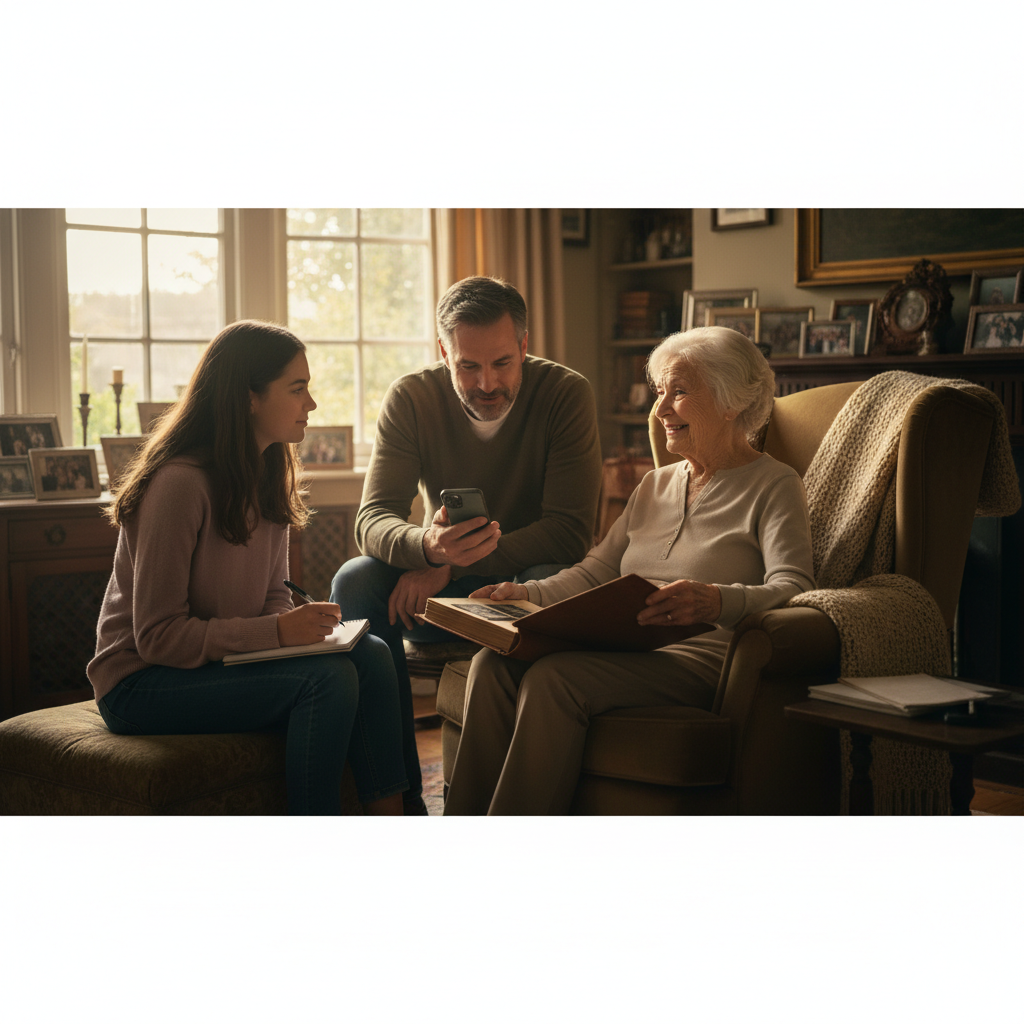 Family Heritage
Detailed article
Use the text-size control at the top for larger text, or switch back to Easy Read at any time.
A family story, recorded with care
A voice recording can preserve more than the sequence of events. It holds a speaker’s own phrasing, pauses, humour, and way of describing people and places.
The most important preparation is relational, not technical: ask whether the person wants to take part, explain what you hope to record, and make clear who may listen to it. The Oral History Association’s best-practice guidance describes preparation, interviewing, preservation, and access as connected responsibilities.
Agree on the purpose and boundaries first
Begin with a conversation before you reach for the record button. Say why you would like to hear the story and what you plan to do with the recording. Will it stay with the family? Might it be shared with relatives who live elsewhere? Could it ever be posted online or given to an archive? Those choices are different, and agreement to talk is not automatically agreement to publish.
Ask what subjects feel welcome and what should remain private. Agree on whether names, a home address, or details about other living people should be omitted. If you intend to share beyond the immediate family, discuss that specifically and record the permission in a form both people can understand.
Consent is not a test of memory or a demand for disclosure. The speaker can tell a story in fragments, correct themselves, change direction, or decide not to continue. If a topic seems difficult, do not press for a dramatic revelation. A straightforward “Would you rather leave that there?” gives the person room to choose.
Prepare a few open questions
Choose one manageable theme rather than trying to record an entire life in one sitting. It might be a first job, a childhood home, a family celebration, a move to a new place, or how an everyday object came into the family.
Write a short list of open prompts, then leave space to follow the speaker’s lead. Questions such as “What do you remember about the kitchen where you grew up?” or “How did that journey begin?” invite a fuller answer than “Was the kitchen small?” Ask one question at a time. When a detail matters, try a gentle follow-up: “What happened next?” “Who was there?” or “How did you come to remember that?”
Avoid putting a conclusion into the question. “You must have been frightened, weren’t you?” suggests an answer; “What do you remember feeling?” leaves it to the speaker. A quiet pause is not a problem to fix. Give the person time to gather a thought, and listen rather than repeatedly filling the silence with your own memories. The Smithsonian Archives’ guide to oral-history interviews similarly emphasizes open questions, attentive listening, respect, and flexibility.
Set up a simple recording
Pick a room where the two of you can sit comfortably and hear one another without raising your voices. Close a door if that helps, and notice steady sounds such as a fan, television, kitchen appliance, or traffic through an open window. You do not need to make the room unnaturally silent; just reduce avoidable noise. Make sure the seating and route into the room work for the participant, and offer a break or a shorter session if that is more comfortable.
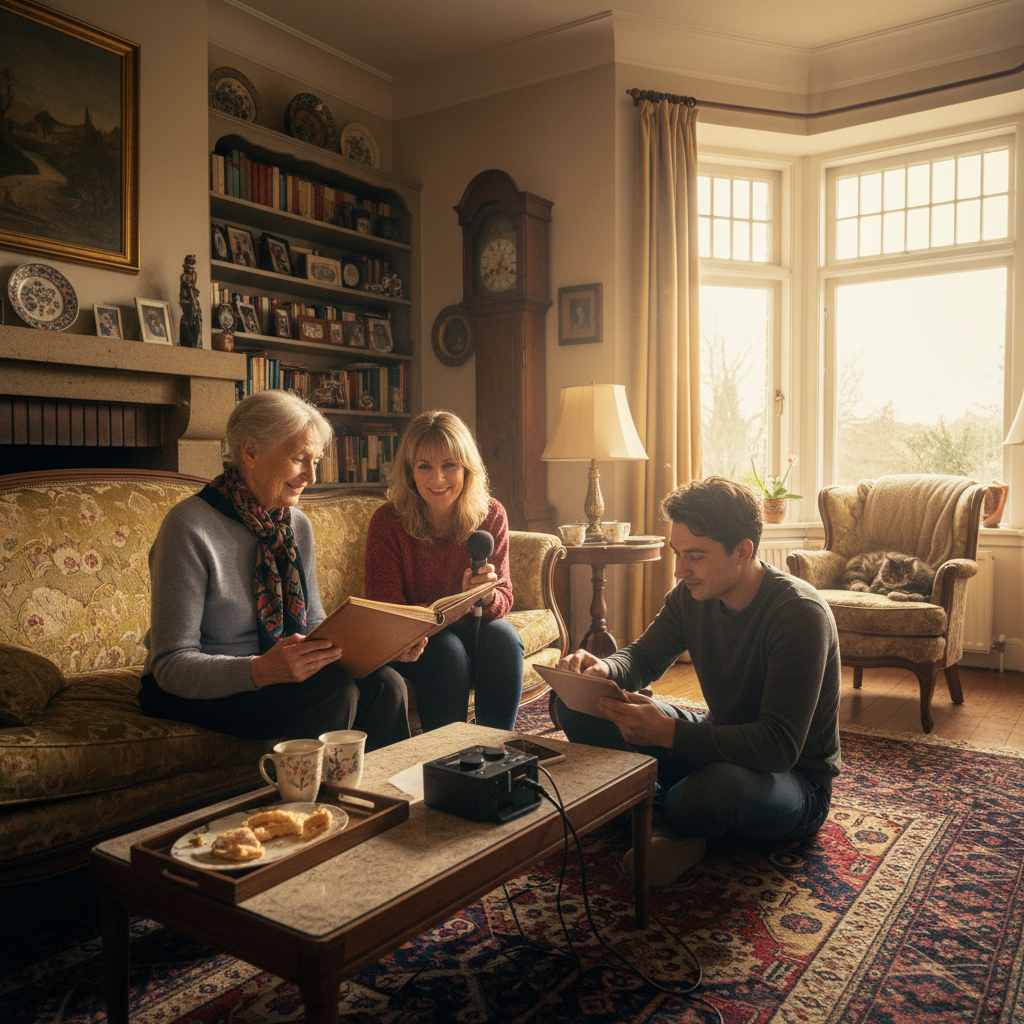
Put the phone or recorder on a stable surface between you, close enough to capture both voices. Before the full conversation, make a short test recording. Play it back to check that voices are clear and that the microphone is not covered by a hand, cushion, or case. Silence notifications, check that there is enough battery and storage, and keep the device plugged in if appropriate.
At the start, state the date, the general setting (for example, “at home,” rather than a street address), who is speaking, and the topic. Then ask on the recording whether the participant agrees to this recording and restate the agreed limits in plain language. Keep the introduction brief. If the person later changes their mind about a section, stop and agree together what to do with that part.
Let the conversation breathe
Begin with something easy and concrete, such as asking the speaker to describe a place, routine, or object. Keep your outline nearby but do not treat it as a questionnaire that must be completed. A related memory may be more meaningful than the next prompt you planned. If the conversation wanders, you can gently ask how the new subject connects, or simply let the speaker continue.
Keep your own interjections short so they do not cover the speaker’s words on the recording. Notes can help you remember a name or a follow-up, but do not make note-taking more important than listening. If a name, date, or place is unclear, ask for spelling or clarification when it feels natural. Memories are personal accounts; if you later write a factual family history, distinguish what the speaker remembers from details confirmed in documents.
There is no required duration. You might agree to talk for a short period and check whether the person wants to continue. Close with a gentle question such as, “Is there anything you would like to add, or anything you would prefer me not to share?” Thank the person without implying that they owed you a story.
Save, label, and share thoughtfully
Soon after recording, play the file to confirm it works. Give it a clear filename that includes the speaker’s chosen name or label, the date, and a short topic—for example, Aunt-May_2026-10-25_childhood-home. Add a brief note with the participant’s preferred name, the general subject, and any agreed sharing limits. Keep that note with the recording rather than relying on memory.
Make more than one copy and store them separately, such as on a computer and an external drive, with a secure cloud copy only if that suits the family’s privacy expectations. Check periodically that the files still open, and move them when devices or storage services are retired. The US National Archives’ audio guidance recommends organized files, multiple copies on different media and locations where possible, and attention to future format and storage changes. A cloud account alone is not a complete preservation plan.
Do not forward the recording simply because it is easy to share. Confirm that the intended recipients and uses fit the participant’s agreement. If a wider public release or a deposit with a library is being considered, revisit permissions and the receiving institution’s requirements first.
A small beginning is enough
One thoughtful conversation can open a door to more stories, or it can stand on its own. It is to create a respectful opportunity for someone to speak in their own way, while leaving them in control of what is remembered and who gets to hear it. A quiet room, a clear question, and careful stewardship after the conversation are a good place to begin.
Reading path
Continue this topic
A gentle four-part start for recording voices, memories, and the stories that make a family feel like home.
Pillar guides in this path
A gentle next step
Keep a related family story
If this topic brings a family memory to mind, you can save it at your own pace.
“Thank you for sharing this quiet moment of reading with us.”
Every piece in the MemContinuity library is preserved to spark gentle conversations, honor generational memory, and support the health and comfort of our families.
MemContinuity editorial team
MC-HERITAGE-20260921-010 · Publication archive reference
Cross-device reading sync
Sign in to your MemContinuity account to optionally sync your article reading progress across your phone, tablet, and computer.
Themes & topics
Editorial guidance & care
Our publications are designed to be practical, gentle, and respectful. For specific medical, mobility, or travel arrangements, we recommend consulting local providers or relevant municipal services.
Continue with purpose
Part of a curated reading journey
Related publications
 Family Heritage
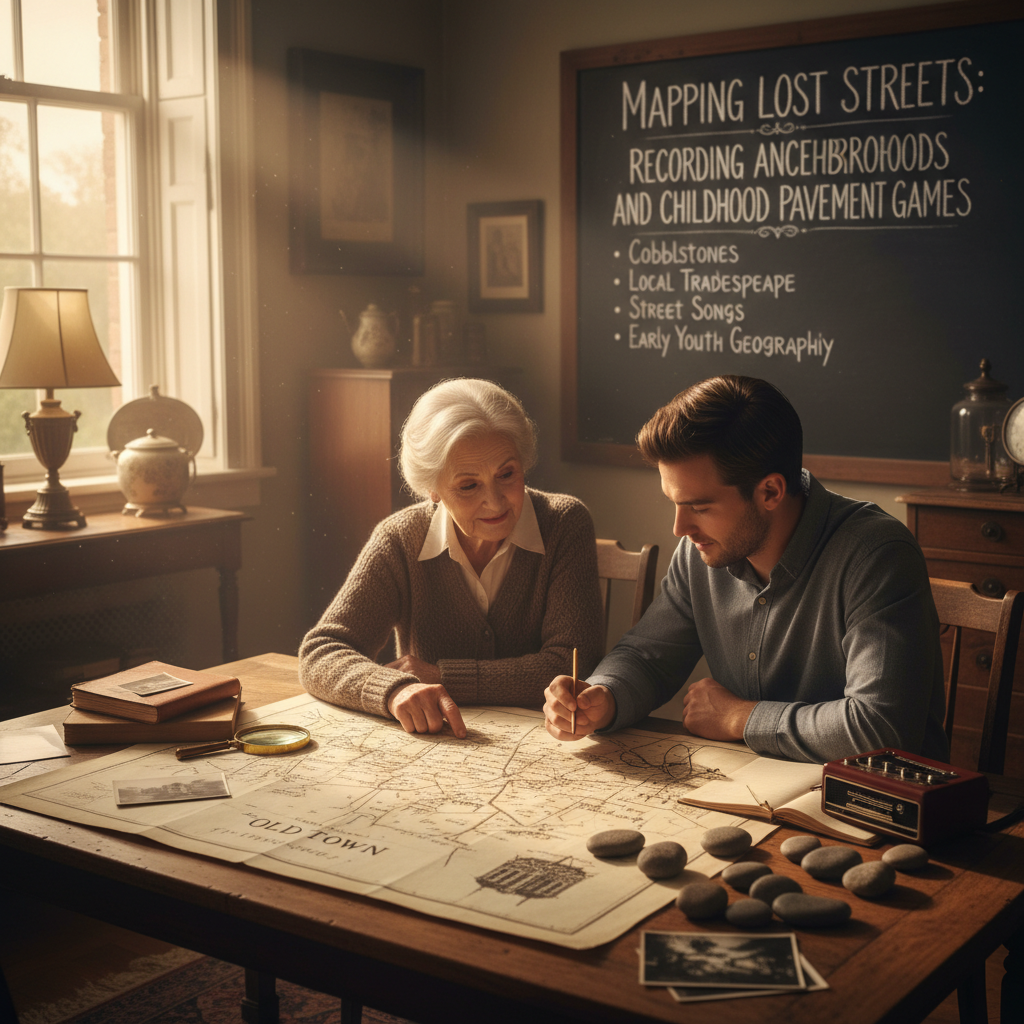
Mapping Lost Streets: Recording Ancestral Neighborhoods and Childhood Pavement Games
A guide to interviewing parents about cobblestones, local tradespeople, street songs, and the geography of their early youth.
 Family Heritage
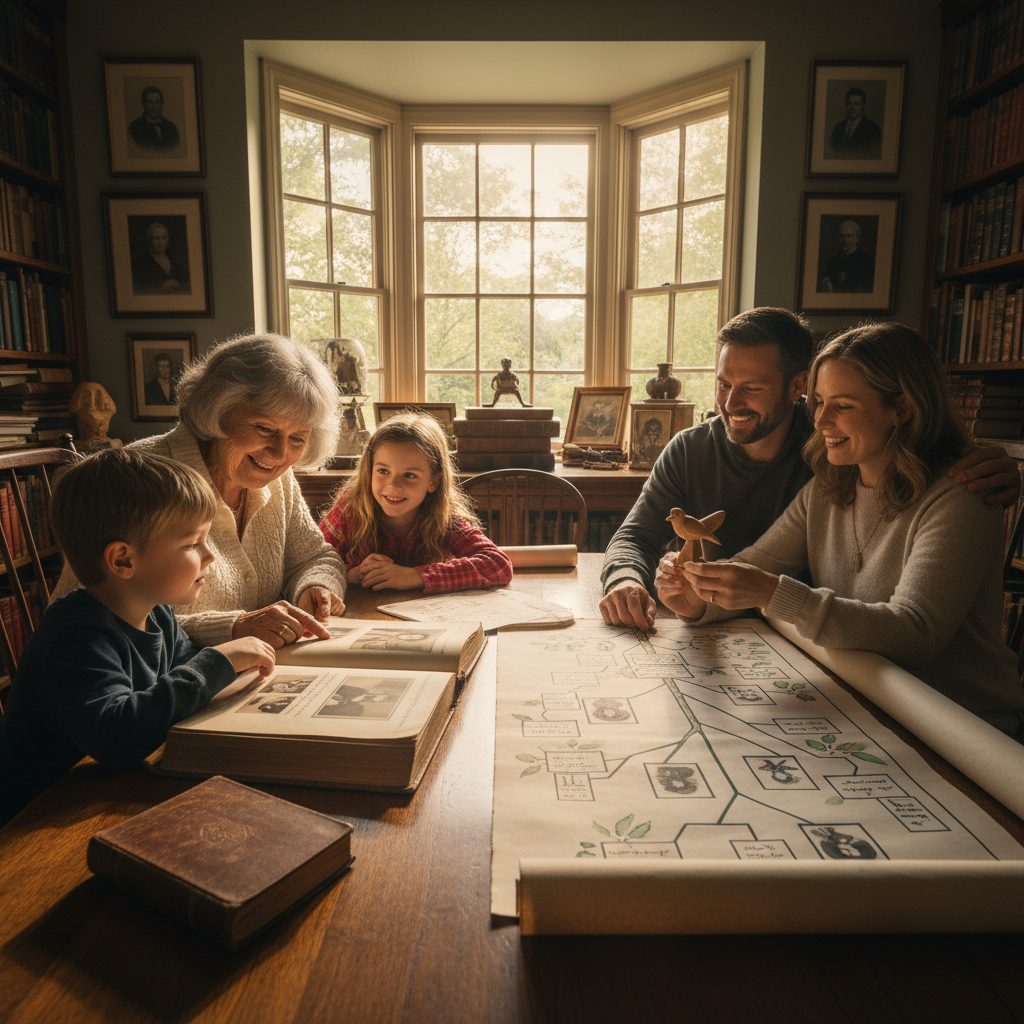
The Living Family Tree: Engaging Children and Grandchildren with Tactile Ancestral Lore
Moving beyond dry genealogical charts to share character anecdotes, physical likenesses, and enduring virtues with youth.
 Family Heritage
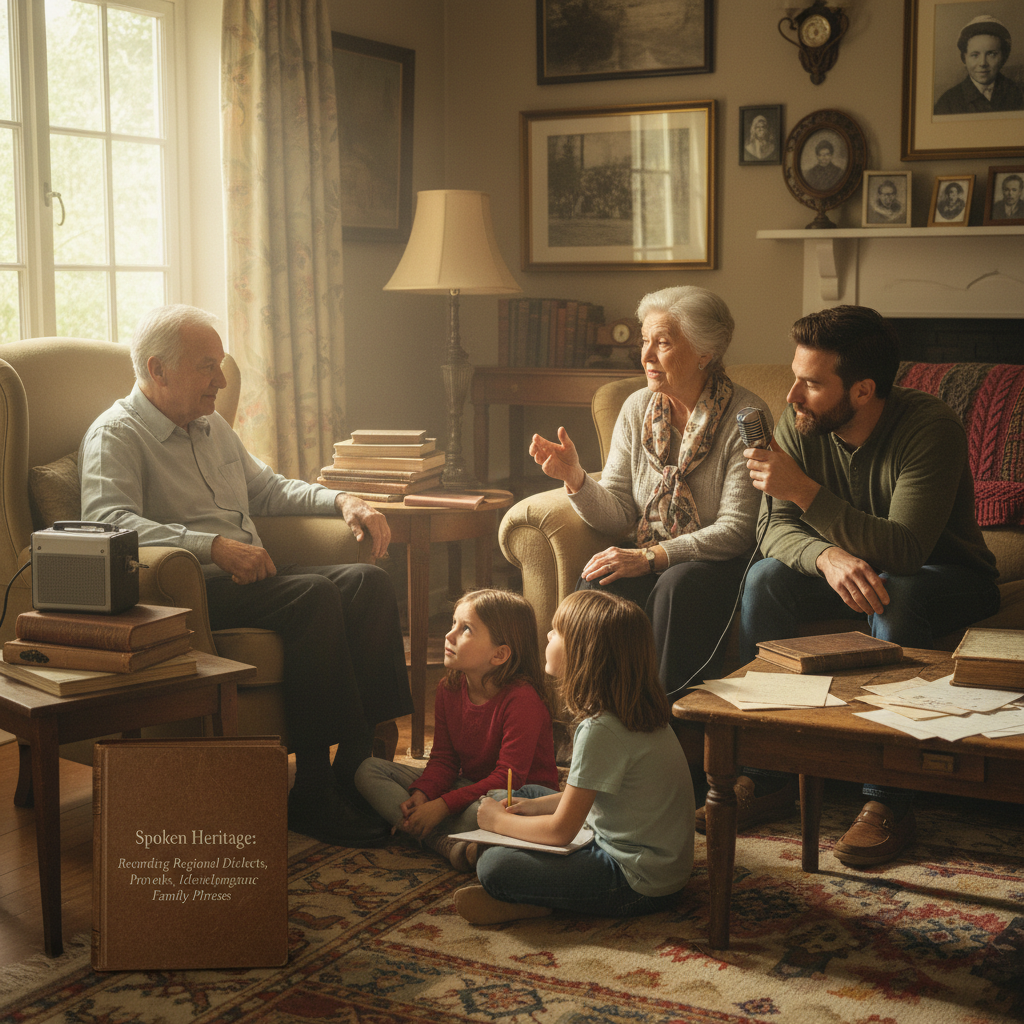
Spoken Heritage: Recording Regional Dialects, Proverbs, and Idiosyncratic Family Phrases
Why the peculiar sayings of our grandparents carry irreplaceable cultural texture that standard written histories miss.
Share the story
Family discussion cards
Take one card at a time. There are no right answers—only memories worth hearing.
What memory did this article bring to mind?
Who in the family might have a story or photograph to add?
What is one small thing we could save, share, or do next?
A quiet conversation can be a meaningful family keepsake.
Subscribe to MemContinuity Publications
Receive thoughtful reflections, local heritage guides, and slow travel stories delivered directly to your inbox. No spam, privacy respected.