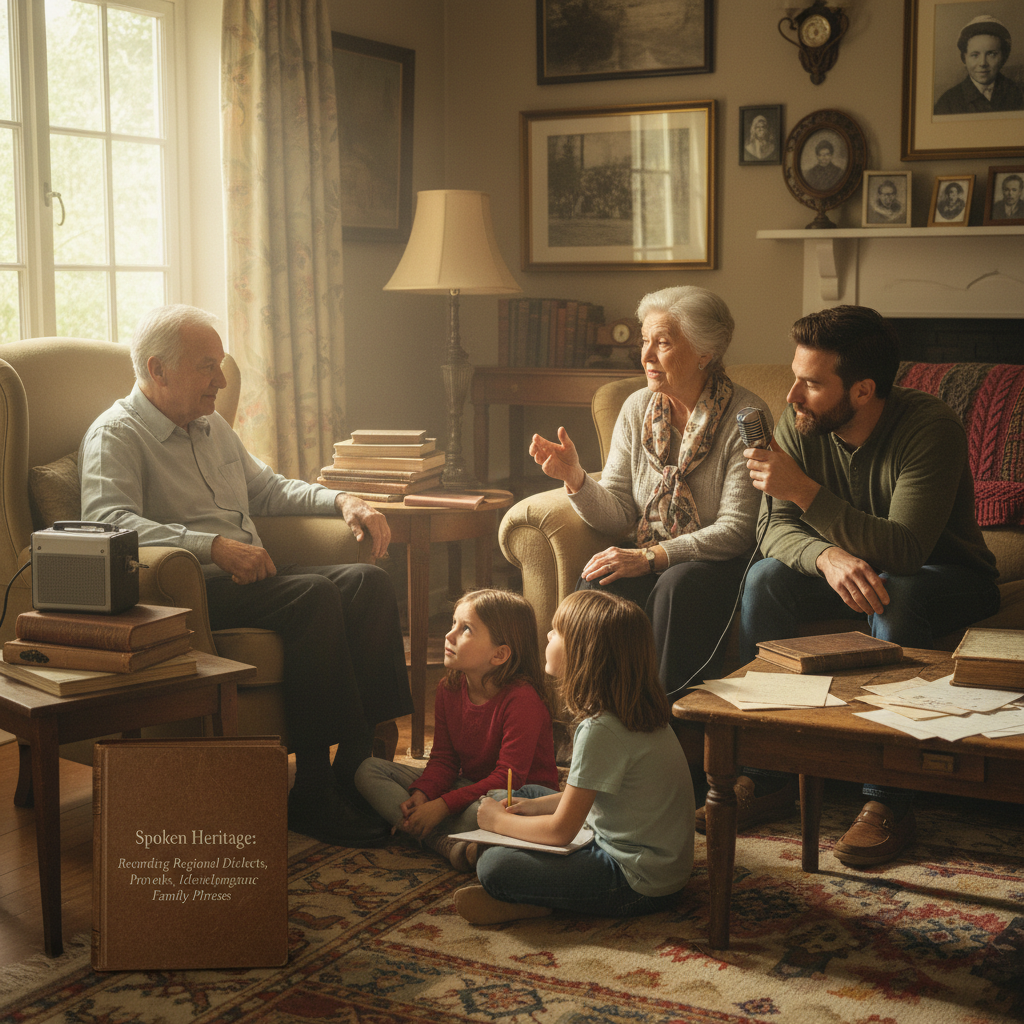
Spoken Heritage: Recording Regional Dialects, Proverbs, and Idiosyncratic Family Phrases
A practical, consent-first guide to recording the words, meanings, pronunciations, and family contexts that make spoken heritage distinctive.
A compatible device voice is not available. You can still read this article on screen.
 Family Heritage
Detailed article
Use the text-size control at the top for larger text, or switch back to Easy Read at any time.
Why the peculiar sayings of our grandparents carry irreplaceable cultural texture that standard written histories miss.
Why a phrase is more than its definition
Family speech carries information that a polished written account can lose: a local pronunciation, a playful rhythm, a proverb used at a particular moment, or a phrase whose meaning is understood only by relatives. The Smithsonian Center for Folklife and Cultural Heritage includes sayings and expressions among forms of family folklore, alongside stories, customs, nicknames, games, and photographs. It also describes language as part of expressive culture learned through speaking, imitation, and performance. Smithsonian glossary
Begin with permission and purpose
Ask whether the person would like to talk about expressions they remember. Explain what you hope to record, who may hear or read it, where you plan to keep it, and whether you might share it beyond the family. A person can decline a question, pause, stop, or ask that a recording remain private. Agreement to have a conversation is not automatically agreement to publish it. The Oral History Association recommends discussing informed consent, intended use, access, restrictions, and review expectations as part of preparation. Oral History Association Best Practices
If a phrase involves another living person, a painful event, a private nickname, or a story that could embarrass someone, ask whether it is appropriate to preserve or share it. Do not treat family membership as permission to circulate every detail. You can keep a private note, use a pseudonym, omit identifying information, or leave the material out. For public or institutional projects, check the repository's release and restriction policies before recording.
Invite speech rather than testing memory
Choose a quiet, comfortable setting and a time that suits the speaker. Phones and recorders can be distracting, so explain the device and make a short test recording before beginning. If recording feels unwelcome, take notes instead. Keep a session brief or let the speaker set the pace; there is no required number of phrases or minutes.
Use open invitations instead of quizzes. You might ask, “What expressions did people use when you were growing up?” or “Is there a saying you remember from work, school, or home?” Follow the speaker's lead with gentle prompts: “When would someone say that?” “Do you remember who used it?” “Would you say it differently now?” A person may remember the scene but not the exact wording, or may offer more than one version. Record uncertainty as uncertainty; do not fill gaps with guesses.
Let the speaker say the phrase naturally, and, if they wish, repeat it at a comfortable pace. Ask what words mean to them rather than assuming a dictionary definition. Note who used the expression, the situation, the speaker's own explanation, and whether it was affectionate, teasing, formal, or serious. These details help a future listener understand how the phrase functioned without claiming that every relative used it the same way.
Capture pronunciation and context
A written spelling cannot fully represent a voice. If the speaker agrees, audio preserves intonation, rhythm, pauses, and pronunciation that a typed quotation may flatten. Write down the date, broad setting, speaker's chosen name or pseudonym, language or dialect label in the speaker's own terms, and the topic. Avoid recording a home address or other unnecessary identifying details. The Oral History Association advises documenting interview context and using high-quality recordings where practical.
If you make a transcript, decide how to represent speech with the speaker rather than silently “correcting” grammar or spelling. A close transcript can retain repetitions and distinctive wording, while a light-edit transcript can be easier to read. State which approach you used. Mark a word as unclear when you cannot hear it; do not substitute a likely word without a note. Where a sound distinction matters, ask the speaker how they describe it, or keep the audio available alongside the text. Do not invent a phonetic spelling system unless you understand and consistently explain it.
One small record can include the phrase as spoken, a plain-language gloss, a short account of when it is used, and any alternate form the speaker remembers. Ask the person to review names, spellings, and sensitive details if that is practical. Preserve their wording and viewpoint rather than recasting a saying to make it sound more polished.
Keep the record usable and safe
Give each recording and note a clear, neutral filename, such as a date and topic rather than a revealing phrase or private name. Keep a simple index so relatives can find an item without listening through every file. After recording, transfer the original from the device and make more than one backup. Store copies separately rather than relying on a single phone or computer. The Oral History Association recommends redundant digital copies in different physical locations, documentation of the project, and attention to long-term preservation and access.
Choose a format that your household can open and maintain. Keep the original recording and an unaltered transcript or notes, then make separate working copies if you edit. Review the backups occasionally and move files when devices or storage services become obsolete. A family collection may be private; it does not need to be uploaded to a public platform to be valuable. If you consider donating it to a library or archive, ask first about accepted formats, permissions, access restrictions, and whether the repository can honor them.
Make room for variation
Avoid labeling an expression “broken,” “incorrect,” or quaint. Dialect is part of how people communicate and belong; it should not be treated as a performance for others. The Smithsonian's language work emphasizes community-driven approaches and respect for the voices and worldviews of language communities. That principle is a useful guide for family projects too, while a household archive should not be mistaken for specialist language documentation or a language-revitalization program. Smithsonian Language Vitality Initiative
A gentle first-session checklist
Before you begin, ask permission, explain the intended audience, and agree on whether the conversation is for private family use or possible sharing. Prepare a few broad prompts, but let the speaker choose the direction. During the conversation, listen without correcting, allow silence, and note the surrounding context. At the end, ask what should stay private and whether the speaker wants to review the record. Then label the files clearly, make separate backups, and record any access limits alongside them.
Preserving spoken heritage need not become a formal interview project. It can begin with a respectful question and a careful note, provided the speaker remains in control of what is shared. Treat each phrase as a piece of living language, keep its context attached, and leave room for different memories to coexist.

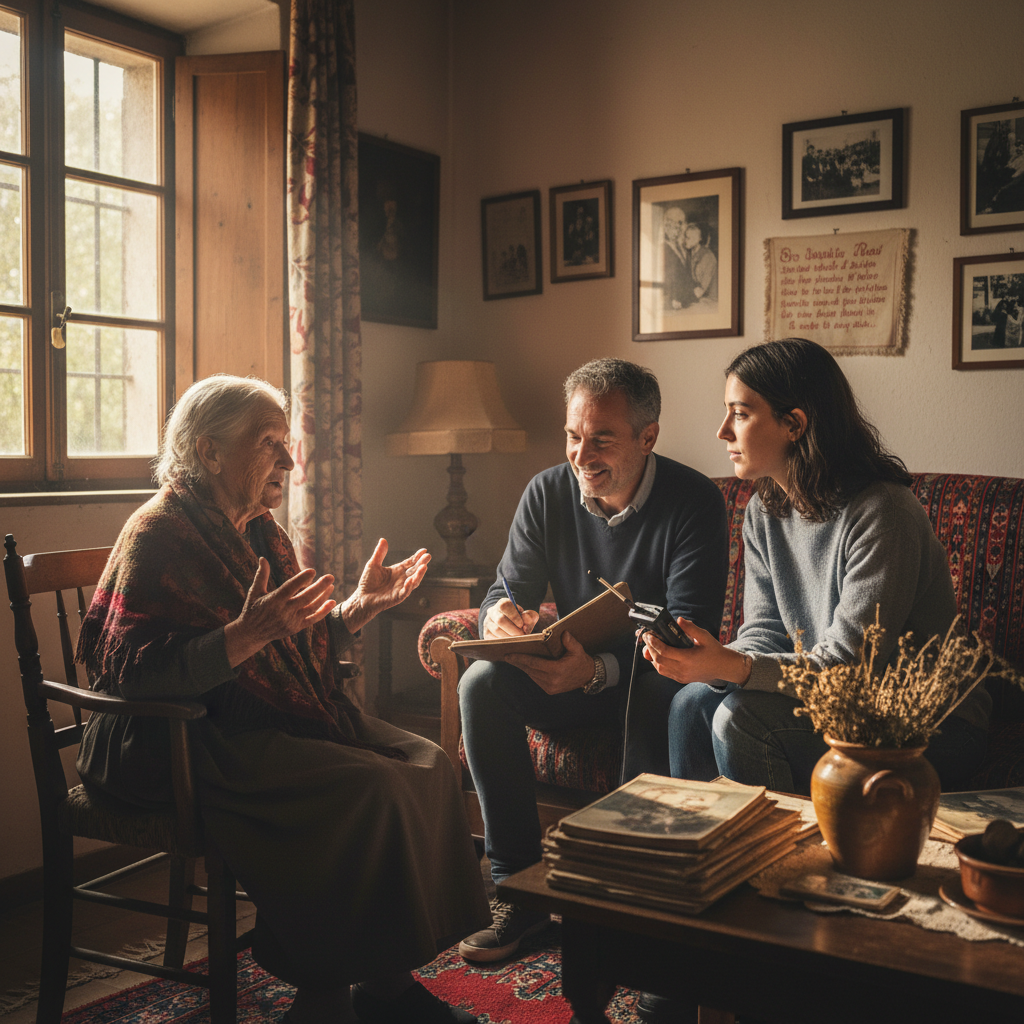
Reading path
Continue this topic
A gentle four-part start for recording voices, memories, and the stories that make a family feel like home.
Pillar guides in this path
A gentle next step
Keep a related family story
If this topic brings a family memory to mind, you can save it at your own pace.
“Thank you for sharing this quiet moment of reading with us.”
Every piece in the MemContinuity library is preserved to spark gentle conversations, honor generational memory, and support the health and comfort of our families.
MemContinuity editorial team
MC-HERITAGE-20260522-022 · Publication archive reference
Cross-device reading sync
Sign in to your MemContinuity account to optionally sync your article reading progress across your phone, tablet, and computer.
Themes & topics
Editorial guidance & care
Our publications are designed to be practical, gentle, and respectful. For specific medical, mobility, or travel arrangements, we recommend consulting local providers or relevant municipal services.
Related publications
 Family Heritage
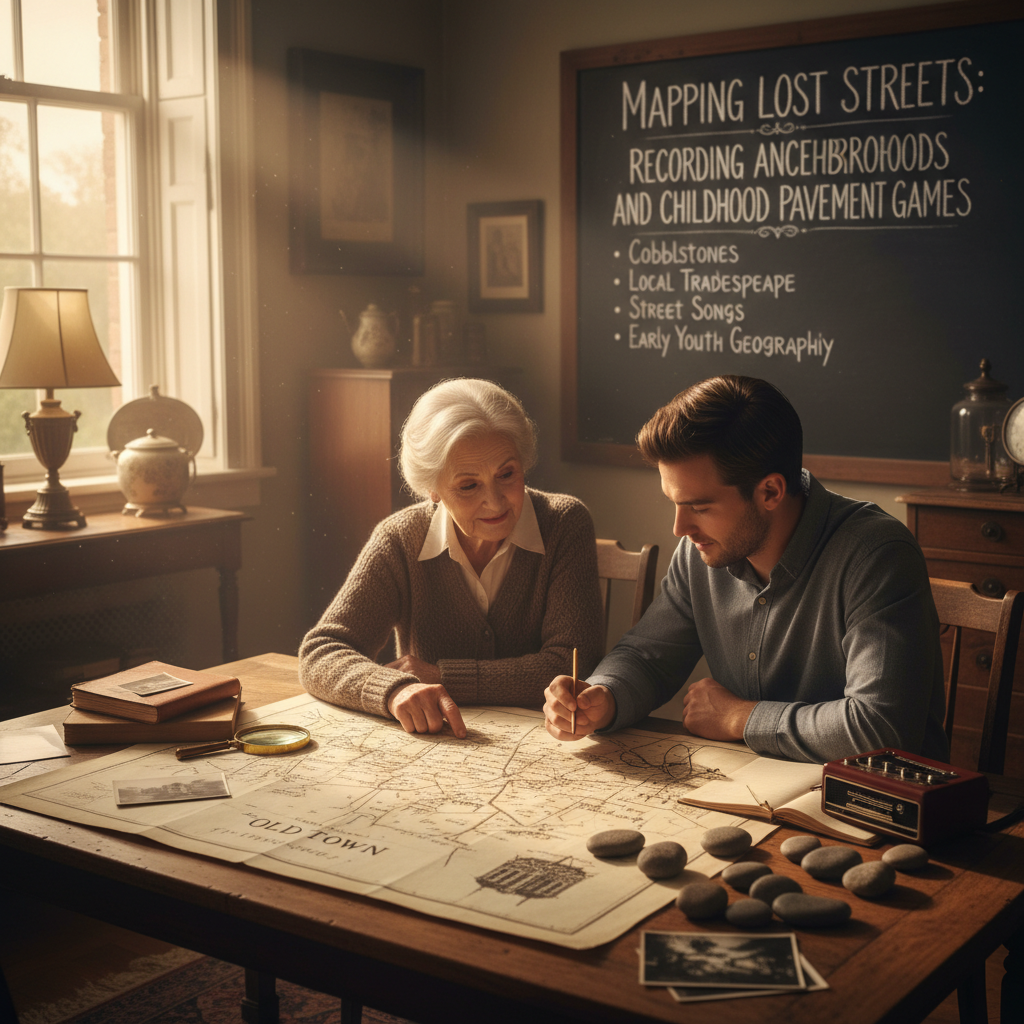
Mapping Lost Streets: Recording Ancestral Neighborhoods and Childhood Pavement Games
A guide to interviewing parents about cobblestones, local tradespeople, street songs, and the geography of their early youth.
 Family Heritage
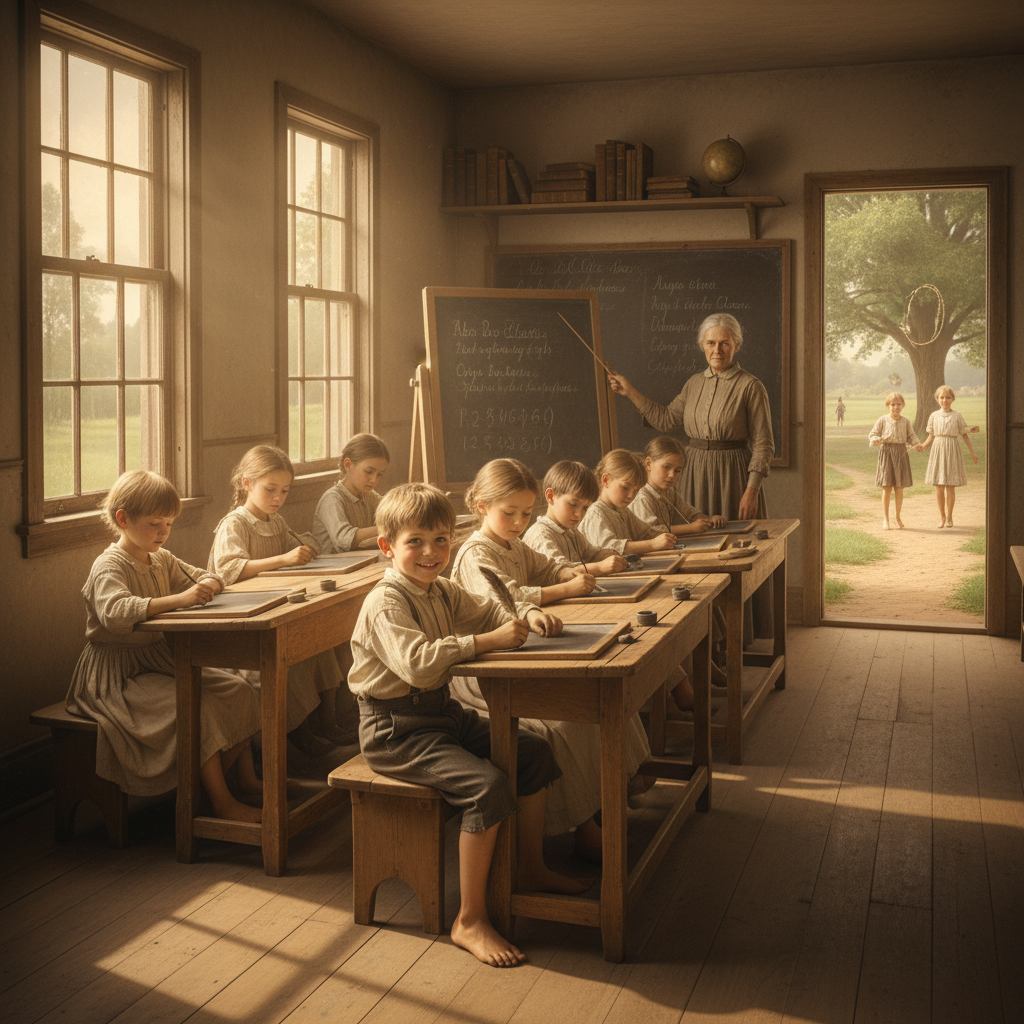
The Village Classroom: Remembering Slate Boards, Inkwells, and Schoolyard Friendships
A nostalgic oral interview roadmap exploring early education, walking barefoot to school, and childhood academic triumphs.
 Family Heritage
Unlocking the Family Attic: Safely Handling Century-Old Trunks and Boxes
How to open forgotten heirloom chests without damaging crumbling paper, dried leather, or insect-damaged albums.
Share the story
Family discussion cards
Take one card at a time. There are no right answers—only memories worth hearing.
What memory did this article bring to mind?
Who in the family might have a story or photograph to add?
What is one small thing we could save, share, or do next?
A quiet conversation can be a meaningful family keepsake.
Subscribe to MemContinuity Publications
Receive thoughtful reflections, local heritage guides, and slow travel stories delivered directly to your inbox. No spam, privacy respected.