Build a Family Tree Album With Evidence and Living-Person Privacy
Start a family tree album with a clear research log, honest evidence labels, public archive leads, and respectful permission for living relatives.
A compatible device voice is not available. You can still read this article on screen.
 Family Heritage
Detailed article
Use the text-size control at the top for larger text, or switch back to Easy Read at any time.
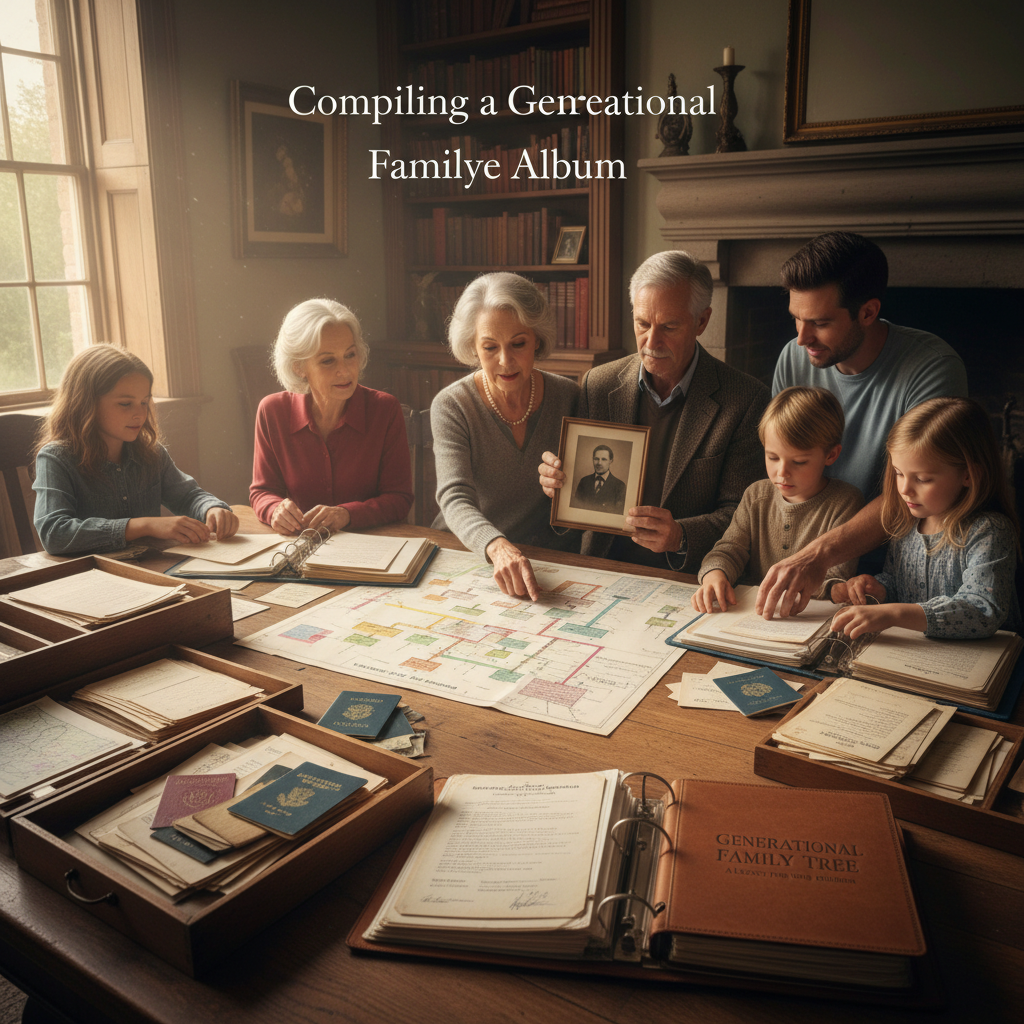
Start your family tree album with one documented person, one focused question, and a research log. Put each fact beside the record that supports it, label unconfirmed family stories as leads rather than facts, and ask living relatives before you include or share their personal details. The result can be warm and readable without hiding what is known, what is uncertain, and what still needs research.
Make the album a record of evidence, not just a chart
A family tree is easier to trust when it shows how a relationship or life event was established. Give each important claim a short, retraceable note: where the information came from, what the record says, and when you consulted it.
The Board for Certification of Genealogists standards recommend documenting facts, assessing evidence, resolving conflicts, and writing conclusions based on the strongest evidence. Use that as a practical habit, not a reason to postpone the album.
Use three clear evidence labels
Give every relationship, date, place, or story one of these labels in your notes. The labels prevent an appealing story from silently becoming a stated fact.
- Supported conclusion: the available records support the claim, and any important conflict is explained in a note.
- Record-based detail: a specific document or image reports the detail, but it may not by itself establish the wider relationship. For example, a death record may name a parent, but should be read alongside other evidence.
- Family story or research lead: someone remembers it, an old note suggests it, or an online tree repeats it, but you have not yet found sufficient supporting records.
Do not turn a label into a verdict for all time. A newly found record can strengthen, weaken, or change a conclusion. A careful album makes that revision visible rather than quietly overwriting the earlier trail.
Begin with the people and questions you can name
Start with yourself, a parent, grandparent, or another person whose basic details your family can identify. Write a narrow question instead of beginning with a distant surname. Examples include: “Were Maria Soler and Josep Pujol the parents of this Joan Pujol?” or “Which town did Elena García leave before arriving in Argentina?” These are illustrative questions; your question should name one person, one relationship or event, and a likely place and time.
For the first pass, gather what you already hold: certificates, letters, labelled photographs, funeral cards, notebooks, and conversations with relatives. Treat a memory as context, record who shared it and when, and do not treat it as a substitute for a record.
The U.S. National Archives genealogy guide lists record groups such as census, military, immigration, naturalization, and land records. The useful lesson applies beyond the United States: let the person’s place and life event guide the next record search, rather than searching every collection at once.
For a conversation-first start, use the prompts in how to record a family story at home. Keep the recording or notes with the person’s permission and the date. A spoken recollection can point to a town, nickname, occupation, or document worth checking.
Copy this research-log worksheet before you search
A research log stops you from repeating searches and gives the album a transparent trail. Make one entry for every useful search, including searches that found nothing. Copy the following worksheet into a notebook, document, or spreadsheet.
Family-tree research log
Research question: What exactly am I trying to establish?
Person or family group: Include known name variants, approximate dates, and places.
Starting information: Write what the family already says or holds. Mark each item as a memory, note, photograph caption, certificate, or other item.
Repository or website searched: Name the archive, collection, catalogue, or family-held item. Include the direct record link or reference number where available.
Search terms and date: Record spellings, locations, date ranges, and the day you searched.
What the source actually says: Transcribe the relevant names, dates, places, and relationships. Keep interpretation separate from transcription.
Evidence status: Supported conclusion, record-based detail, family story, or research lead.
Conflicts or gaps: Note differences in age, spelling, place, parent names, or other details. Do not average conflicting dates into a new date.
Next action: Identify one specific next source, person to ask, or archive enquiry.
A log is especially helpful when names are common or spellings change. An unsuccessful search is not proof that an event did not occur.
Use Catalan and Spanish public archives as discovery tools
For Catalan family lines, Arxius en línia is the Generalitat de Catalunya portal for holdings, documents, and digital objects from the National Archives of Catalonia, the regional archive network, and some municipal and private archives. It provides descriptions and contextual information for material including photographs, maps, audiovisual items, and sound. Search an ancestor’s locality and alternate spellings alongside the surname, then save the collection name and reference in your log.
A catalogue result is a lead, not proof. Read the full description, identify the creating body and date, and check whether the result is an image, description, or an item to request. The portal’s terms distinguish private research use from other uses and require attention to personal-data and image rights; check the holding archive’s conditions before reusing an image.
For wider Spanish research, the Ministry of Culture’s Portal de Archivos Españoles, PARES publishes descriptions and digital images from state-archive collections, but notes that not every described document has an image. Keep the description and repository reference, then plan a request or follow-up search rather than assuming a missing online image means the record never existed.
If your research crosses borders, repeat the same method: identify the place and period, use an official archive catalogue where possible, log the search, and read the record in context. Do not infer a biological or legal relationship from a shared surname alone.
Ask permission before you write about living people
Living people deserve a different standard from ancestors. The European Commission explains that personal data is information relating to an identified or identifiable living individual, and that collecting, storing, and sharing it are forms of processing. Its overview also notes that data about deceased people is outside the GDPR, while use outside a purely personal or household setting can trigger data-protection duties. See the European Commission’s data-protection explanation for the official overview.
For a family album, ask before including a living person in anything shared beyond a private working file. Ask separately about their name, birth details, photograph, voice recording, contact information, and sensitive family story. State who will see it, whether it may be copied or posted online, and how they can change their answer. Record the permission’s date and scope in the research log.
This is not a substitute for local legal advice. Privacy law and archive access rules vary by country and circumstance. The BCG code of ethics also calls for informed consent or removal of identifying detail before publishing personal, genealogical, or genetic information disclosed by someone. For a public-facing version, leave out exact birth dates, addresses, contact details, identification numbers, medical information, and private family conflicts unless there is a clear, appropriate reason and permission.
Keep two versions when needed: a private research file with restricted access and a shareable album with only approved details. A relative’s decision not to participate should be respected without argument.
Turn research into pages people will want to read
A good album does not need a page for every name. Build a small, clear structure:
- Opening map: a simple tree showing only relationships whose status you can explain.
- Person page: preferred name, name variants, dates and places with their evidence label, a short narrative, and a source note.
- Place page: a map, photograph, or short description that explains why a town, street, parish, workplace, or migration route matters to the family.
- Story page: a clearly marked oral history, attributed to the speaker and dated. Keep it distinct from the evidence note.
- Research notes page: unanswered questions and the next leads, so children and grandchildren can continue without guessing where to begin.
For example, an illustrative caption might read: “Family story, told by Ana Ruiz in May 2026: her grandfather travelled from Lleida to Barcelona for work. Research lead: look for residence, employment, or travel records before presenting the move as established.” This preserves the voice while being honest about its status.
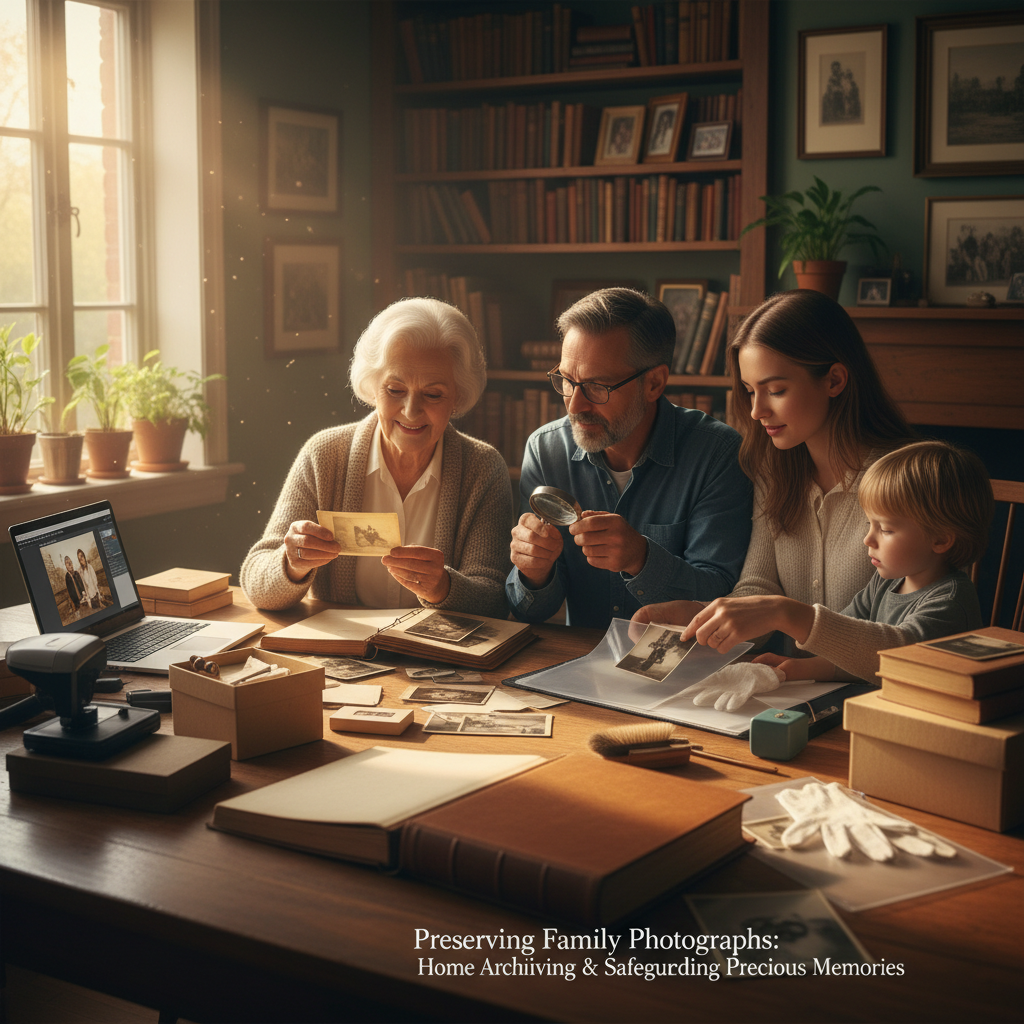
Use copies or scans for working pages, and keep originals protected. When photographs become part of the album, the related guide on preserving family photographs can help you plan their care separately from the research process.
Frequently asked questions
Do I need a document before adding someone to the tree?
No. Add the person as a clearly marked research lead or family story. Do not place an unconfirmed relationship in the main chart as if it were established. Include the source of the lead and the next record you plan to seek.
Is an online family tree evidence?
Treat it as a clue, not final evidence. Note the creator, access date, and any cited records, then look for the underlying documents yourself. This follows the evidence-led practice of citing sources actually used and testing conclusions against the strongest available evidence.
What should I do when two records disagree?
Preserve both details in the log, identify what each source says, and ask which source was created closest to the event and by whom. Look for additional records that explain the difference. Do not conceal the conflict; resolving conflicting evidence is part of the Genealogical Proof Standard.
Can I include living relatives in a printed album?
Ask their permission if the album will be shared beyond your own private use, and explain the audience. Keep exact personal details out of a broadly distributed copy unless the person has expressly agreed. For online publication or uncertain situations, check the applicable local rules.
What if an archive catalogue has a description but no digitised document?
Keep the full reference in your log. The PARES portal specifically explains that not every described item has a digital image. Check whether the holding archive offers a request, appointment, or further catalogue information rather than treating the online gap as a dead end.
Sources and scope
This guide draws on the following sources:
- Arxius en línia, Generalitat de Catalunya
- Portal de Archivos Españoles, PARES, Ministry of Culture
- Start Your Genealogy Research, U.S. National Archives
- Data protection explained, European Commission
- Ethics and Standards, Board for Certification of Genealogists
Archive portals show what is described or available; they do not by themselves establish family relationships, and search coverage may be incomplete. Begin with one log entry and one carefully labelled page. Add only claims your sources support, and leave the rest as open questions for the next family researcher.
After organising evidence and permissions, you can explore family-tree tools as an optional way to arrange the material. Keep your research log and independent copies whichever tool you choose.
Reading path
Continue this topic
Explore names, places, migrations, and the practical beginnings of a family tree—one clue at a time.
Pillar guides in this path
Family Heritage
Surnames and Roots: Distinguishing Authentic Regional Etymology from Commercial Heraldic Fictions
Family Heritage
The Ocean Crossing: Documenting Ancestral Migration Routes, Ships, and New Beginnings
Family Heritage
Mapping Lost Streets: Recording Ancestral Neighborhoods and Childhood Pavement Games
Printable checklist
Start a family tree album: first-session checklist
A gentle next step
Place the story in your family tree
When you are ready, add a name, relationship, or memory to your private family tree.
“Thank you for sharing this quiet moment of reading with us.”
Every piece in the MemContinuity library is preserved to spark gentle conversations, honor generational memory, and support the health and comfort of our families.
MemContinuity editorial team
MC-HERITAGE-20260830-032 · Publication archive reference
Cross-device reading sync
Sign in to your MemContinuity account to optionally sync your article reading progress across your phone, tablet, and computer.
Themes & topics
Editorial guidance & care
Our publications are designed to be practical, gentle, and respectful. For specific medical, mobility, or travel arrangements, we recommend consulting local providers or relevant municipal services.
Continue with purpose
Part of a curated reading journey
Related publications
 Family Heritage
QR Codes on Headstones: Permissions, Privacy and Lasting Care
A practical guide to adding a QR memorial code without assuming permission, permanence, or privacy: confirm the cemetery’s rules, separate the code from the hosted archive, and make a family handover plan.
 Family Heritage
Preserve Old Family Photos: Safe Storage, Scanning and Backups
Protect old family photographs at home with safer handling, photo-safe storage, non-destructive scanning, clear metadata, and reliable backups—without risky cleaning or DIY restoration.
 Family Heritage
Record Family Stories: Consent, Interviews and a Memory Archive
A practical, consent-led guide to recording family oral histories, creating accessible transcripts, organizing a memory archive, backing it up, and writing a legacy note that is not a legal will.
Share the story
Family discussion cards
Take one card at a time. There are no right answers—only memories worth hearing.
What memory did this article bring to mind?
Who in the family might have a story or photograph to add?
What is one small thing we could save, share, or do next?
A quiet conversation can be a meaningful family keepsake.
Subscribe to MemContinuity Publications
Receive thoughtful reflections, local heritage guides, and slow travel stories delivered directly to your inbox. No spam, privacy respected.